
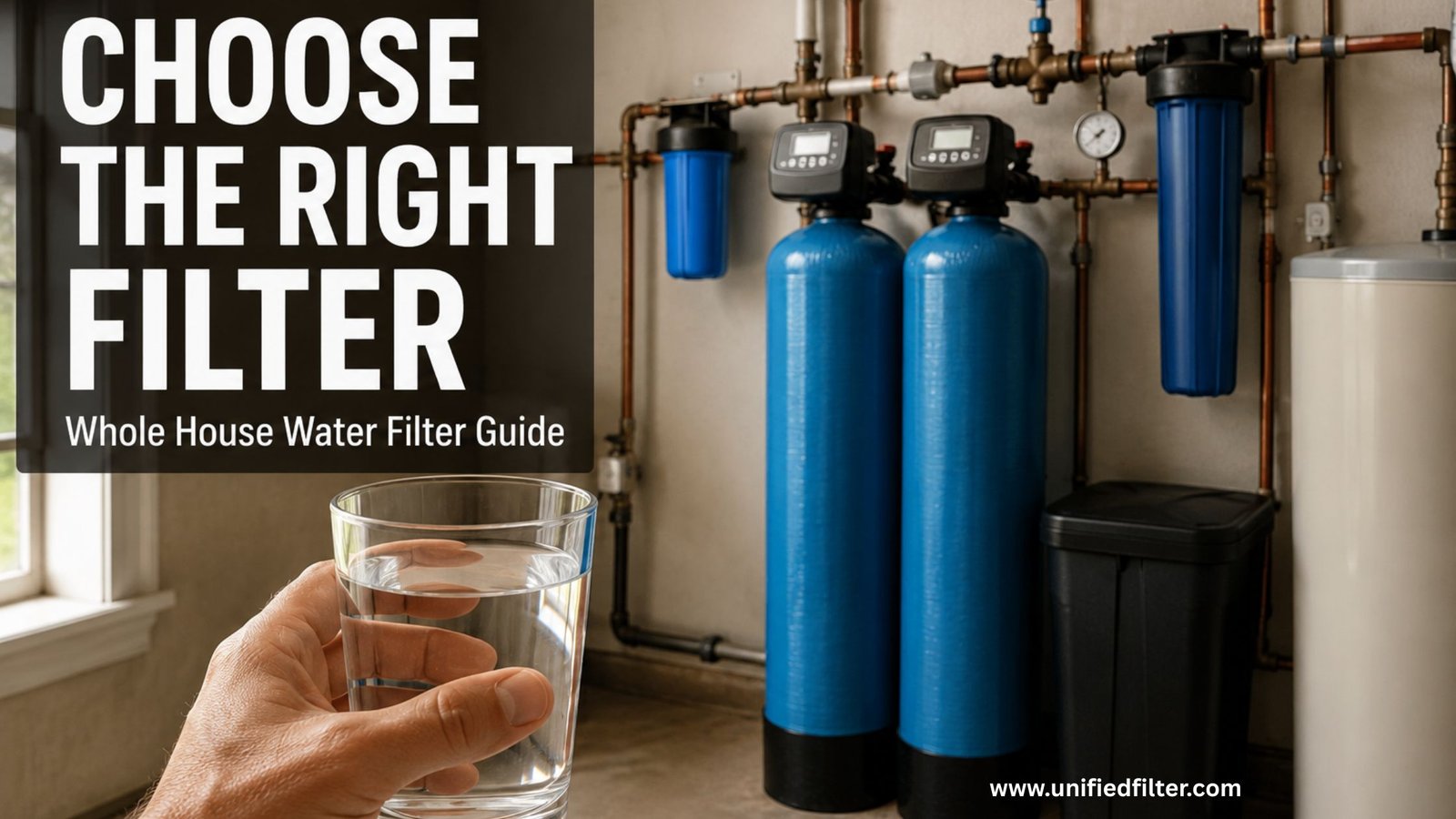

A whole house water filter is installed on your main water line and treats every tap in your home. There is no single best system, the right whole house water filter depends on your specific contaminants and water source. Test your water first, match the technology to the problem (carbon for chlorine, ion exchange for hardness, oxidizer for iron, UV for bacteria), and size the system for your home’s peak flow rate.
A whole house water filter, also called a point-of-entry (POE) system, installs where your main water line enters the home, treating water before it reaches any tap, shower, or appliance.
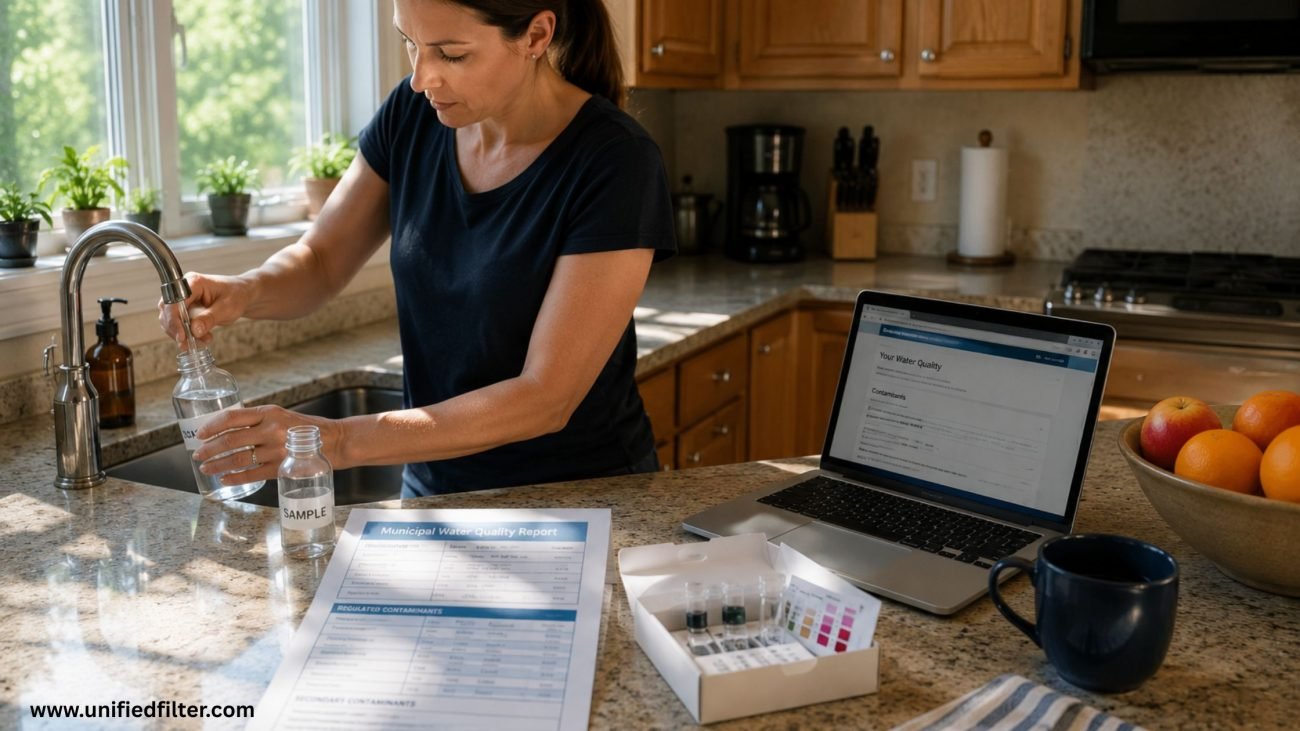
Test Your Water Before Choosing a Whole House Water Filter
 If you are on city water: Pull your Consumer Confidence Report (CCR), search your city name and water quality report. Check the disinfectant type (chlorine vs chloramine), hardness level, lead service line notices, and any PFAS detections. This single document tells you most of what you need to know.
- If you are on well water: Get a professional lab test covering bacteria (total coliform, E. coli), iron, manganese, hardness, pH, sulfur, and nitrates. Taste and smell alone will not reveal everything, bacteria and nitrates have no taste.
Chlorine vs chloramine matters more than most people realize. Standard activated carbon handles free chlorine well but performs poorly against chloramine at normal flow rates. If your utility uses chloramine, you need catalytic carbon with adequate contact time, not a standard carbon tank.
Whole House Water Filter Technology
Once you know what is in your water, matching the right whole house water filter technology is straightforward. Here is the complete breakdown:
| Water Problem | Technology Needed | Certification | Does NOT Fix |
| Chlorine taste/odor | Standard activated carbon | NSF 42 | Hardness, bacteria, PFAS |
| Chloramine | Catalytic carbon (longer EBCT) | NSF 42 | Standard carbon often fails this |
| Lead, cysts, VOCs | Carbon + KDF media | NSF 53 | Hardness minerals |
| Hard water (calcium/magnesium) | Salt-based ion exchange softener | NSF 44 | Chlorine, bacteria, PFAS |
| Iron, manganese, sulfur | Air injection oxidizer | None standard, performance based | Chlorine, hardness |
| Bacteria, viruses | UV sterilization (after sediment filter) | NSF 55 | Chemical contaminants |
| PFAS | RO at point of use (kitchen tap) | NSF P473 / 58 | Whole-house PFAS rarely certified |
| Sediment | Sediment pre-filter (5 micron) | NSF 42 | Dissolved contaminants |
A whole house carbon filter does not soften hard water, remove bacteria, or eliminate iron and manganese. These require completely different technologies, ion exchange, UV, and oxidizing media respectively. Buying a carbon-only system expecting it to fix well water problems is the most common and expensive mistake.
Also check: RV Water Filter
How to Size a Whole House Water Filter for Your Home
Undersizing is the second most common mistake. A system that barely meets your peak flow when installed will fall short within months as the media accumulates sediment and pressure drop increases.
| Home Size | Bathrooms | Minimum Flow Rate | Recommended GPM Rating |
| Small (1-2 bath) | 1-2 | 6-8 GPM | 9-12 GPM |
| Medium (2-3 bath) | 2-3 | 9-12 GPM | 12-15 GPM |
| Large (3-4 bath) | 3-4 | 12-15 GPM | 15-20 GPM |
| Very large (4+ bath) | 4+ | 15+ GPM | 20+ GPM |
To calculate your actual peak demand,count fixtures that could run simultaneously, shower, dishwasher, washing machine, kitchen faucet and add their typical flow rates. A WaterSense showerhead uses about 2.0 GPM; older showerheads can use 2.5+ GPM. A washing machine fill cycle uses roughly 2-3 GPM. Add these up and choose a system rated comfortably above that total.
Empty bed contact time (EBCT) matters too. This is the time water spends inside the carbon media, calculated by dividing media volume by flow rate. Longer EBCT means better contaminant removal, especially for chloramine. A 1.5 cubic foot tank at 8 GPM gives about 1.4 minutes of contact time. The same flow through a 1.0 cubic foot tank drops to roughly 0.9 minutes, which may not be enough.
Best Whole House Water Filter Systems
Here is an honest comparison of systems that actually fit common scenarios
| System | Type | Flow Rate | Capacity | Best For | Price Range |
| SpringWell CF1 | Tank, carbon + KDF | 9-20 GPM | 1,000,000 gal | City water, low maintenance | $900-$1,400 |
| Aquasana Rhino | Tank, dual stage | 7 GPM | 1,000,000 gal / 10 yr | Long-term low maintenance | $900-$1,300 |
| Kind E-1000 | Cartridge, compact | 15 GPM | Scheduled cartridge swap | Tight spaces, lab-verified | $700-$1,000 |
| iSpring WGB32B | Cartridge, 3-stage | 15 GPM | Scheduled cartridge swap | Budget-friendly option | $200-$350 |
| Pelican PC1000 | Cartridge, 4-stage | 12 GPM | Scheduled cartridge swap | No electricity needed | $700-$1,000 |
| SpringWell WS1 + SS1 | Combo, filter + softener | 9-20 GPM | Filter + full softening | Hard city water + contaminants | $1,800-$2,500 |
- For most city water households: A tank-based carbon system like SpringWell CF1 or Aquasana Rhino offers the best long-term value, high capacity, minimal maintenance, strong chlorine and chloramine reduction.
- For tight spaces or budget installs: Cartridge systems like Kind E-1000 or iSpring WGB32B perform well but need scheduled cartridge changes rather than years of set-and-forget operation.
- For hard city water: A combo unit pairing a carbon filter with a salt-based softener (like SpringWell WS1 + SS1) handles both chlorine and hardness in one footprint.
Whole House Water Filter for Well Water
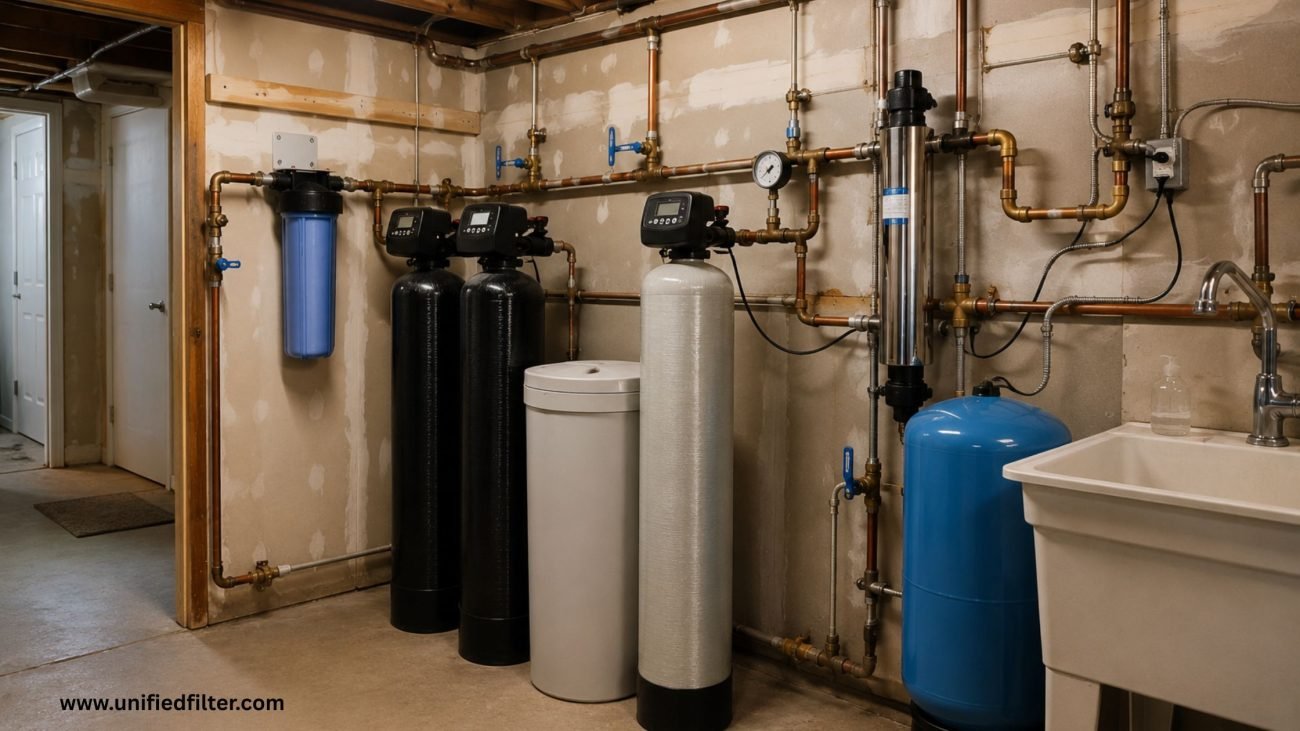
Well water needs a different approach entirely. Treatment order matters, sediment removal first, then oxidation for iron and sulfur, softening for hardness, and UV disinfection for bacteria in that sequence. Getting the order wrong reduces effectiveness and shortens equipment life.
A whole house carbon filter alone, even a premium one, does nothing for the iron, manganese, sulfur, or bacteria typical of private wells. Well water households typically need a multi-stage system,sediment pre-filter, an oxidizing media filter (like SpringWell WS), and often a UV sterilizer added after.
Does a Whole House Filter Replace Your Fridge Water Filter?
No,and this is worth knowing before you spend $1,000+ assuming you can skip your fridge filter afterward.
A whole house carbon or KDF system reduces chlorine, chloramine, and many VOCs at the point of entry. But most whole house systems are not certified to NSF 401 for pharmaceuticals and emerging contaminants, and they are typically not certified for PFAS. Your genuine EveryDrop or Samsung fridge filter, NSF 401 certified, covers contaminants the whole house system may not.
Think of it as layers, not replacement. The whole house system protects every tap and your plumbing. The fridge filter adds a final layer of certified protection specifically for your drinking water and ice.
Whole House Water Filter Maintenance
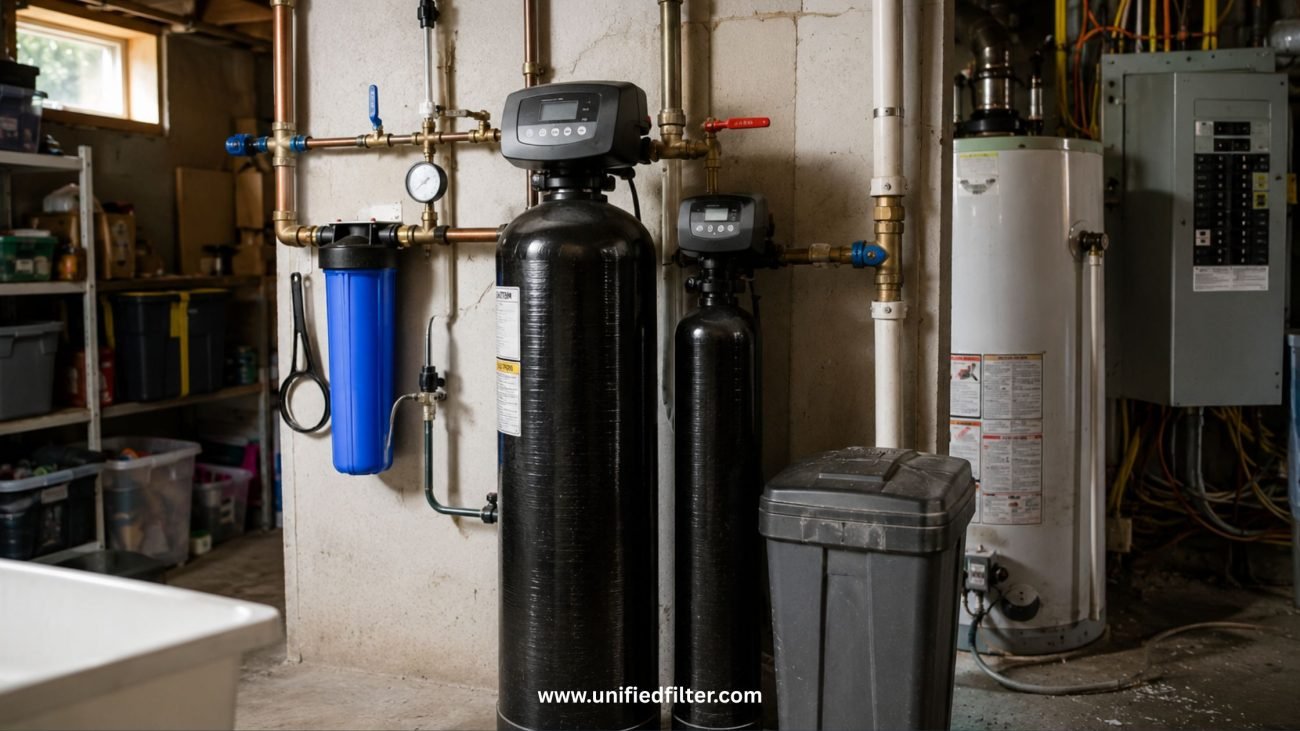
Maintenance varies significantly by system type. Here is what each requires:
- Sediment cartridges: Replace every 1-6 months depending on water quality
- Carbon media in backwashing tanks: Lasts 1 to several years depending on disinfectant type and usage
- Cartridge-based carbon systems: Replace on manufacturer schedule, typically every 6-12 months
- UV lamps: Replace annually regardless of how they look
- Softener resin: Typically lasts 10-15 years with proper regeneration
Monitor pressure differential and water quality changes rather than following a rigid calendar, these indicate when media is loading up faster or slower than expected.
Frequently Asked Questions
What is the best whole house water filter?
There is no single best system, it depends on your water. SpringWell CF1 is strong for city chlorine and chloramine. Well water needs a multi-stage system with sediment, oxidation, and UV.
Does a whole house water filter soften hard water?
No, standard carbon whole house filters do not remove hardness minerals. You need a separate salt-based softener using ion exchange for that.
How do I size a whole house water filter?
Calculate your peak simultaneous water demand from fixtures like showers and appliances, then choose a system rated comfortably above that flow rate in GPM.
Does a whole house filter replace a fridge water filter?
No, whole house systems are typically not certified for pharmaceuticals or PFAS. Keep your NSF 401 certified fridge filter for that layer of protection.
How much does a whole house water filter cost?
Cartridge systems range $200-$1,000. Tank-based systems range $700-$1,400. Combo filter-softener units range $1,800-$2,500.